
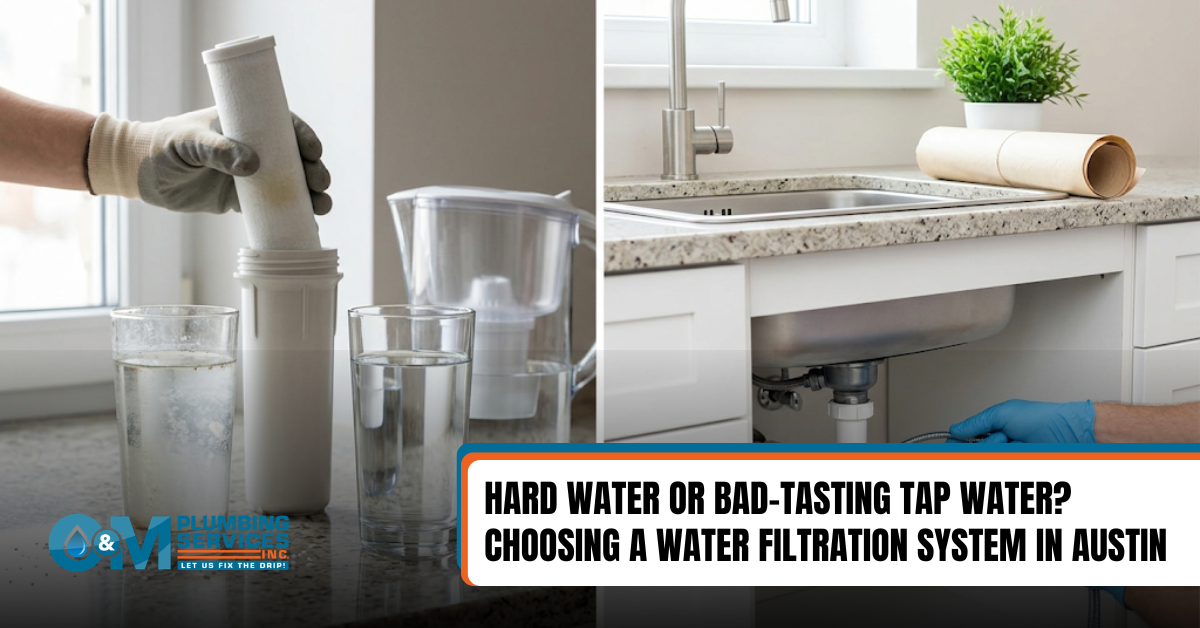
Choose a water softener when calcium and magnesium are causing scale, white buildup, soap scum, or appliance wear. Choose a whole-home filter when you want to reduce sediment, chlorine taste, odor, or other target substances throughout the home. Choose reverse osmosis for highly filtered drinking and cooking water at a specific faucet. Many Austin area homes benefit from a combined system because each treatment method solves a different problem.
You unload the dishwasher, and every glass has cloudy white spots. The shower door looks chalky again, even though you cleaned it two days ago. Then you fill a drinking glass from the faucet and notice a chlorine-like taste or odor.
These problems do not always call for the same equipment. A water filtration system Austin homeowners choose for taste may not solve hardness. A water softener that prevents scale may not remove the dissolved substances you want reduced in drinking water. Reverse osmosis may improve water at the kitchen sink, but it usually does not treat every shower, appliance, and fixture in the house.
Austin Water reports that it tests drinking water several times every day and publishes annual water quality reports for customers. That means municipal water is monitored, but homeowners may still want treatment for hardness, taste, odor, sediment, or personal water-quality goals.
This guide explains how each system works, what it can and cannot solve, and how to avoid paying for equipment that does not match your actual problem.
Why Austin Area Water Leaves Spots, Scale, or Bad Taste
Water can meet public drinking standards and still leave deposits, taste different, or create maintenance problems in your home. The key is identifying whether the issue comes from hardness, disinfectant taste, sediment, plumbing conditions, or a mix of factors.
Hardness minerals
Hard water contains dissolved calcium and magnesium. When water heats or dries, those minerals can remain behind as scale. Scale is the white or chalky buildup you see on faucets, shower glass, coffee makers, and heating elements.
A water softener addresses hardness through ion exchange. Ion exchange resin is a material inside the softener tank that captures calcium and magnesium and exchanges them for sodium or potassium ions.
Chlorine taste or odor
Municipal utilities disinfect water to protect public health. Some homeowners notice the resulting taste or smell more than others.
Activated carbon filtration can reduce many taste and odor concerns. Activated carbon is a porous filter material that traps certain chemicals and organic compounds as water passes through it.
Sediment or plumbing-related discoloration
Sand, rust particles, pipe scale, and construction debris may enter household plumbing or loosen from older pipes. A sediment filter captures physical particles before they reach fixtures or treatment equipment.
Austin Water publishes annual and periodic quality data, including reports on finished drinking water. A homeowner should compare those reports with what is happening inside the property, since private plumbing can affect water after it passes the meter.
Pro Tip: Do not buy a treatment system based only on a salesperson’s countertop demonstration. Start with a water test, your utility report, and a clear list of the problems you want solved.
Once you know the likely cause, the visible warning signs become easier to interpret.
Warning Signs Your Home Needs Water Treatment
Water treatment needs often show up in cleaning habits, appliance performance, skin comfort, and drinking-water preferences. One symptom alone may not justify a large system, but several together usually deserve a professional review.
Watch for these signs:
- White scale on faucets and showerheads: This often points to hardness minerals left behind after water evaporates.
- Cloudy spots on dishes: Detergent may struggle to rinse cleanly when water contains higher mineral levels.
- Soap that will not lather well: Hardness minerals react with soap and can create sticky soap scum.
- Dry-feeling skin or dull laundry: Hard water can leave mineral and detergent residue behind.
- Chlorine-like taste or odor: A carbon-based whole-home or drinking-water filter may help, depending on the source.
- Frequent water heater scale: Mineral deposits can collect on heating surfaces and reduce performance.
- Metallic taste or visible particles: This may come from plumbing, sediment, corrosion, or another source that should be tested.
A commonly overlooked sign is rising maintenance. You may replace faucet aerators, showerheads, dishwasher components, and coffee makers without connecting those failures to mineral buildup.
O & M Plumbing describes its water filtration work as including water softener installation and maintenance, reverse osmosis installation, sediment and chlorine reduction, scale prevention, and appliance protection.
Warning: Water that suddenly changes color, smell, or taste may require utility guidance or laboratory testing. Do not assume a standard filter will address an unknown contamination concern.
Understanding the warning signs matters because untreated water problems can create costs far beyond appearance.
What Happens If You Ignore Hard Water or Filtration Problems
Hard water is usually a maintenance issue rather than an immediate health emergency. Still, ignoring it can shorten equipment life and increase the amount of cleaning, soap, and service your home needs.
Scale can collect inside:
- Water heater tanks and heating elements
- Tankless water heater heat exchangers
- Faucets and shower valves
- Dishwashers and washing machines
- Refrigerator water lines
- Coffee makers and humidifiers
The Department of Energy advises that water heater maintenance can help improve efficiency and extend equipment life. Mineral sediment is one reason regular service matters, especially in homes that experience noticeable scale.
A minor water softener maintenance visit may prevent a larger plumbing or appliance repair. A neglected control valve, clogged injector, failed resin bed, or salt bridge can allow hard water back into the home for months.
Taste and odor concerns can also lead families to rely heavily on bottled water. A properly selected reverse osmosis Austin system may provide a more convenient drinking-water option, but it needs timely filter and membrane changes.
EPA guidance explains that point-of-use reverse osmosis can reduce a range of substances in drinking water, but traditional systems may also send several gallons to the drain for each gallon treated. Newer WaterSense-labeled models must meet water-efficiency and performance criteria.
Plumber’s Advice: Treatment equipment does not stay effective forever. Every system needs filter changes, salt, cleaning, sanitizing, media replacement, or membrane service on a schedule.
If you are already dealing with white scale, unpleasant taste, or failing equipment, there is no need to guess. O & M Plumbing provides water filtration service throughout Austin, Pflugerville, Buda, Cedar Park, Leander, Round Rock, and nearby communities. Call for a water assessment and an upfront recommendation based on your home.
The next step is comparing what each system actually does.
Water Softener vs. Whole-Home Filter vs. Reverse Osmosis
These systems are often marketed as if they are interchangeable. They are not. Each one treats a different part of the water-quality problem.
| System | Main Purpose | Where It Treats Water | Best For | Does Not Primarily Solve |
|---|---|---|---|---|
| Water softener | Removes hardness minerals through ion exchange | Whole home | White scale, soap scum, hard-water appliance wear | Most taste, odor, or dissolved contaminant concerns |
| Whole-home filter | Reduces selected sediment, chlorine, odor, or target substances | Water entering the home | Better water at showers, faucets, and appliances | Hardness unless the system includes softening media |
| Reverse osmosis | Pushes water through a semipermeable membrane | Usually one drinking-water faucet | Drinking and cooking water, dissolved-solids reduction | Whole-home scale and shower-water treatment |
Choose a water softener when scale is the main problem
A water softener Pflugerville TX installation makes sense when you see white buildup, stiff laundry, soap scum, or repeated scale-related equipment problems. The system must be sized to household demand and measured hardness.
Choose whole-home filtration for broader taste and odor treatment
Whole-home filtration treats water before it reaches most fixtures. System design may include sediment filtration, activated carbon, or specialized media selected for a confirmed target.
Choose reverse osmosis for drinking and cooking water
Reverse osmosis uses pressure to move water through a semipermeable membrane. The membrane allows water molecules through while reducing many dissolved substances.
EPA defines point-of-use reverse osmosis as a system connected to one fixture or a small number of drinking-water taps, rather than equipment that treats most household water.
For many Austin homes, the best setup is a softener for scale plus an under-sink reverse osmosis system for drinking water. Others need carbon filtration and no softener at all.
A proper recommendation starts with water conditions, household size, flow demand, plumbing space, maintenance preferences, and budget.
DIY Maintenance vs. Hiring a Licensed Plumber
Homeowners can handle basic upkeep on many filtration systems. Installation and plumbing modifications require more care because leaks, cross-connections, drainage errors, and incorrect sizing can damage the home.
What You Can Handle
You can usually perform these tasks if the manufacturer allows them:
- Check the softener salt level.
- Wipe down the brine tank.
- Replace simple refrigerator or countertop filters.
- Watch for leaks around housings and connections.
- Record filter-change dates.
- Follow the manufacturer’s sanitizing instructions.
A salt bridge is a hardened layer of salt that forms inside a brine tank. It can make the tank look full even when the system cannot draw enough salt for regeneration.
When You Must Call a Pro
Call a licensed plumber for:
- Water softener installation Austin projects
- Whole-home filtration connections
- Reverse osmosis drain and faucet connections
- Water softener repair
- Bypass valve problems
- Pressure or flow complaints
- Leaking filter housings
- Plumbing reroutes or code-related changes
The Texas State Board of Plumbing Examiners recommends verifying the Responsible Master Plumber, confirming insurance, obtaining a detailed written estimate, and checking that the license number appears on estimates and invoices.
A plumber to install a reverse osmosis system should also check water pressure, available cabinet space, drain connection, faucet placement, refrigerator routing, and whether pretreatment is needed.
Do Not Do This: Do not install an RO drain saddle or whole-home filter without confirming the correct plumbing method. A poor drain connection can leak, clog, or create an unsanitary cross-connection.
Professional installation becomes more valuable when the system must work with the entire home rather than one fixture.
How Professional Water Filtration Installation Works
A quality installation should start with diagnosis, not a product box. The plumber needs to understand the water, the household, and the plumbing system before recommending equipment.
- Discuss the symptoms, 10 to 20 minutes. The plumber asks about taste, odor, scale, water pressure, appliance problems, and current equipment.
- Review water information, 15 to 30 minutes. The technician may review utility data, perform field testing, or recommend laboratory testing for specific concerns.
- Inspect the plumbing, 20 to 45 minutes. The plumber checks the main water line, drain access, electrical outlet availability, pressure, pipe size, and installation space.
- Size the system, 15 to 30 minutes. Softener sizing depends on hardness and household demand. Filter sizing depends on flow rate, media, and treatment goals.
- Present options and pricing, 15 to 30 minutes. A good estimate explains equipment, labor, valves, drain connections, warranties, maintenance, and expected filter life.
- Install and connect the equipment, 3 to 8 hours. Whole-home systems often require a bypass valve, shutoff valves, drain routing, and secure pipe connections.
- Flush, sanitize, and test, 30 to 90 minutes. The plumber flushes media, checks for leaks, verifies flow, and confirms the equipment operates correctly.
- Explain maintenance, 15 to 20 minutes. You should leave knowing when to add salt, change cartridges, sanitize the RO tank, and schedule service.
O & M Plumbing offers water softener, whole-home filtration, and reverse osmosis installation and service across the Austin metro.
Plumber’s Advice: Ask for written maintenance intervals before installation. A cheaper system with expensive or hard-to-find filters may cost more over five years.
With the installation process clear, homeowners can compare realistic costs.
Water Filtration System Austin Cost Guide for 2026
Water treatment pricing depends on system size, media, plumbing access, brand, water conditions, and installation complexity.
- Equipment model and capacity
- Labor and plumbing materials
- Bypass and shutoff valves
- Drain and electrical requirements
- Startup, flushing, and testing
- Manufacturer and workmanship warranties
- Future filter or media costs
Watch for unusually low bids that leave out installation details. A bargain system can become expensive if it restricts flow, lacks replacement parts, wastes water, or needs early replacement.
EPA reports that traditional point-of-use RO systems may waste five gallons or more for each gallon produced. WaterSense-labeled RO systems are designed to meet a maximum reject-water ratio of 2.3 gallons for each gallon of treated water.
Financing or payment options may make sense for combined whole-home systems. Ask the provider to separate equipment, installation, and optional upgrades in writing.
Prices vary by home. The best estimate comes from a direct assessment of your water, plumbing, and treatment goals.
How to Choose the Right Water Filtration Plumber
A filtration installer should understand plumbing, water chemistry, equipment sizing, and long-term maintenance. Selling equipment is not enough.
Start by checking:
- Texas plumbing license status
- General liability insurance
- Written warranty terms
- Experience with softeners and reverse osmosis
- Access to replacement parts
- Local service coverage
- Clear maintenance pricing
The Texas State Board of Plumbing Examiners provides a public license-search process and advises consumers to verify license information before hiring.
Ask these questions:
- What specific problem will this system solve?
- What test result supports your recommendation?
- Will the system reduce water pressure?
- How often do filters, media, or membranes need replacement?
- What will annual maintenance cost?
- Is the equipment certified to an applicable NSF or ANSI standard?
- Who handles warranty service?
- Can you service the system after installation?
EPA guidance recommends choosing treatment based on the substances you want to reduce and checking certifications for the system’s claimed performance.
Review platforms can also help. Look for detailed Google, Yelp, and Nextdoor reviews that mention installation quality, clean work, explanations, follow-up service, and whether the system solved the original problem.
A local company often has better familiarity with Austin area water conditions and home layouts than a national seller that outsources installation. O & M Plumbing has served the Austin metro since 2011 and offers softener, filtration, and reverse osmosis services.
The final decision should also account for differences across local utility systems.
Local Water Factors Across the Austin Metro
The Austin service area includes several cities and water providers. Water conditions can vary between Austin, Pflugerville, Buda, Cedar Park, Georgetown, Hutto, Lakeway, Leander, Manor, Round Rock, Taylor, Bee Cave, and West Lake Hills.
Austin Water states that it tests drinking water multiple times every day and publishes an annual Consumer Confidence Report. Homeowners should review the report from the utility that actually serves their address, not assume every Austin suburb receives identical water.
Local factors include:
- Source-water differences between utilities
- Seasonal changes in taste or odor
- Hardness variations
- Construction-related sediment
- Older household plumbing
- Pressure differences
- Private wells in some outlying areas
Hardness is especially important when sizing a water softener. The installer should test at the home because treatment settings depend on the actual number, not a broad regional estimate.
Austin’s conservation planning also places growing importance on water efficiency. The city’s long-range water planning focuses on conservation, supply resilience, and efficient water use as the region grows. That makes efficient reverse osmosis equipment and properly programmed softeners more relevant in 2026.
For an RO system, look for efficient equipment and avoid unnecessary reject water. For a softener, correct programming helps prevent excessive salt and water use during regeneration.
No single system is automatically best for every Austin area home. Start with the problem, confirm the water conditions, and choose the least complicated system that solves the issue.
Homeowners Also Ask About Austin Water Filtration
Does Austin have hard water?
Austin area water commonly contains enough calcium and magnesium to cause visible scale in many homes, but hardness can vary by utility and location. The most reliable approach is to test the water at your home. A plumber can use the measured hardness to size and program a water softener correctly.
What is the difference between a water softener and reverse osmosis?
A water softener treats hardness minerals throughout the home through ion exchange. Reverse osmosis treats drinking and cooking water at one faucet by forcing water through a semipermeable membrane. A softener helps with scale and soap scum. RO focuses on reducing many dissolved substances in drinking water.
Is a whole-home water filter worth it?
A whole-home filter may be worthwhile if you want sediment, chlorine taste, odor, or another verified target reduced at most fixtures. It will not automatically soften water. The value depends on what the filter removes, how often the media needs replacement, and whether the system maintains good flow.
Can I connect reverse osmosis water to my refrigerator?
Yes, many reverse osmosis systems can supply a refrigerator or ice maker. The installer must consider distance, tubing size, pressure, and refrigerator requirements. Long runs or low-pressure systems may need a pump or different design.
How often does a reverse osmosis system need service?
Many systems need prefilter and postfilter changes every 6 to 12 months. Membranes often last longer, but actual life depends on water quality, usage, and pretreatment. A reverse osmosis plumber should provide a written service schedule for the installed model.
Frequently Asked Questions
Q: How long does water softener installation take?
A: Most standard installations take about three to eight hours. The job may take longer if the plumber must reroute pipes, add drainage, install an outlet, or remove old equipment. The installer should test for leaks, program the control valve, and explain maintenance before leaving.
Q: Do I need both a water softener and a whole-home filter?
A: You may need both if your home has hardness plus taste, odor, sediment, or chlorine concerns. The softener handles calcium and magnesium. The filter treats the specific substances its media is designed to reduce. Testing helps prevent buying equipment you do not need.
Q: Will reverse osmosis remove every contaminant?
A: No treatment system removes everything. RO can reduce many dissolved substances, but performance depends on membrane type, certification, pressure, maintenance, and pretreatment. Choose a system certified for the substances you are concerned about and replace filters on schedule.
Q: Does a plumber need a Texas license to install a filtration system?
A: Plumbing connections and modifications should be performed under a properly licensed Texas plumbing contractor. Verify the Responsible Master Plumber through the Texas State Board of Plumbing Examiners and ask for the license number on the written estimate.
Q: What warranty should I expect?
A: Warranty coverage varies. Ask about equipment tanks, control valves, electronic parts, filter housings, RO membranes, labor, and service-call exclusions. Get both manufacturer and workmanship warranty terms in writing before installation.
Q: How do I know which system is right for my home?
A: Start with your symptoms, utility report, water test, household size, water use, and budget. A qualified plumber should explain why the recommended system matches those facts. Avoid anyone who recommends the same package for every home.
Get the Right Water Treatment Without the Guesswork
White scale, bad taste, and cloudy dishes may look like one problem, but they often need different solutions. O & M Plumbing can help you compare a water softener, whole-home filtration, and reverse osmosis based on your actual water and plumbing system.
Call O & M Plumbing Services, Inc. to schedule a water filtration assessment in Austin, TX, Pflugerville, Buda, Cedar Park, Leander, Round Rock, Georgetown, or the surrounding metro. Ask about water softener installation Austin service, reverse osmosis installation, repair, and ongoing maintenance.